
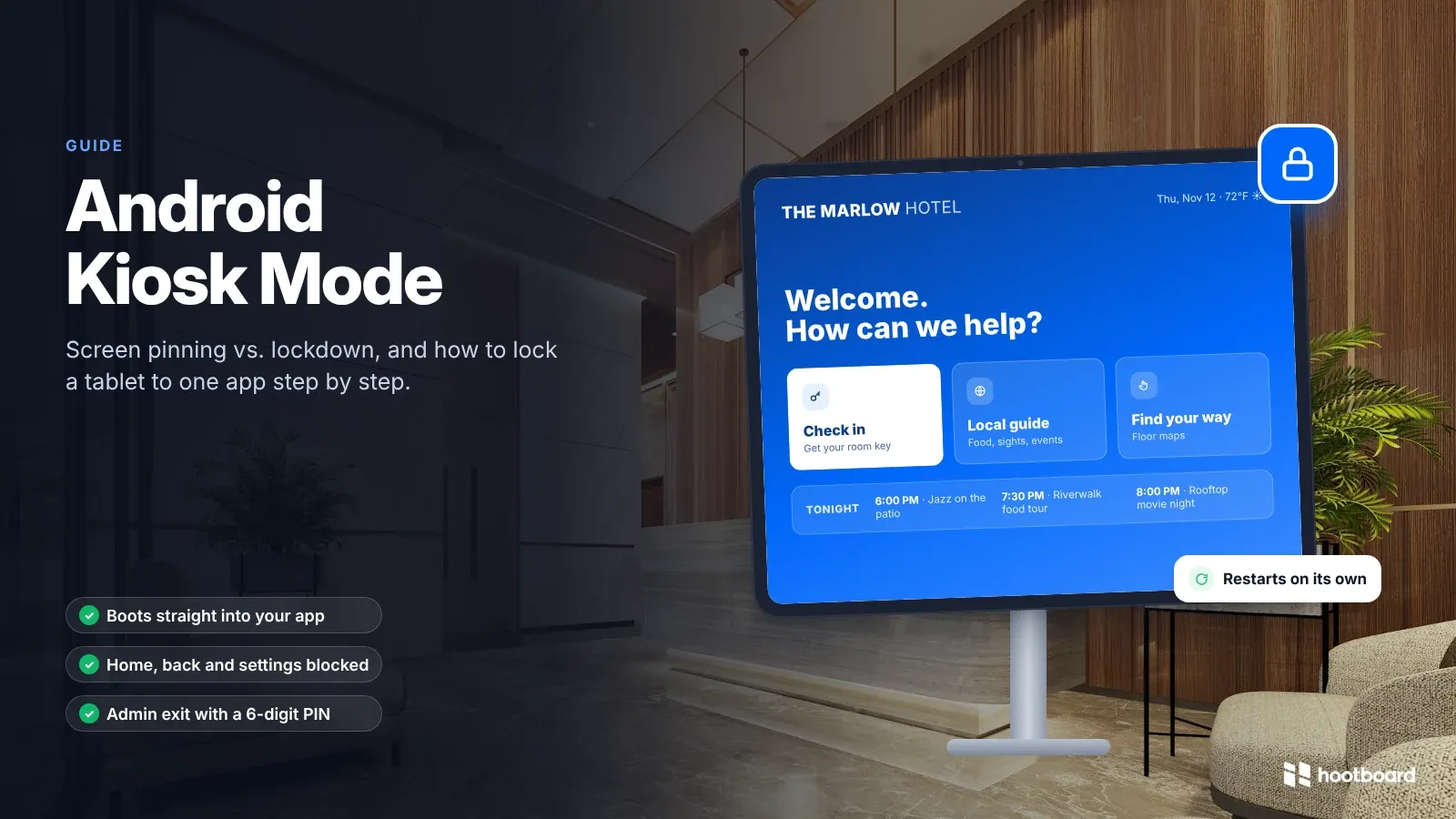
Android kiosk mode locks a tablet or TV to one app so the people using it can't leave, open settings or poke around the rest of the device. If you've set up a check-in tablet in a lobby, a menu screen on a counter or an info screen in a visitor center, you know the problem. Sooner or later someone taps the home button, and your kiosk turns into a regular tablet.
This guide covers the three ways to lock an Android device, what a real lockdown should do, and how to set one up step by step.
What Android kiosk mode actually means
A device in kiosk mode does one job. It opens straight into a single app or website when it powers on, and it stays there.
In practice that means:
- No home screen, recent apps or notification shade for visitors
- No access to Settings, the Play Store or other apps
- The app comes back on its own after a crash, a restart or a power cut
- Only an admin, with a PIN, can get out
Android has this built in. It's called Lock Task Mode, and it's the same feature large companies use to lock down warehouse scanners and point-of-sale tablets. The catch is that Android only hands it to an app that has been set up as the device's device owner. That's why the setup is a little more involved than installing an app from the Play Store.
Three ways to lock an Android device
There are three common ways to keep an Android device on one app. They look alike in a demo, but they behave very differently a week later in a busy lobby.

Screen pinning (called app pinning on some devices) is under Settings > Security. It's handy when you're standing next to the device. But anyone who knows the button combination can unpin it, and after a restart the device opens to the normal home screen.
Kiosk browser apps show a website full screen and hide the address bar. How tight the lock is depends on the app. Without device-owner rights, Android still lets people reach the home button or the notification shade.
Device-owner lockdown is the only option that holds up when nobody's watching. The app takes control of the home screen, the system bars and Settings. It also starts your kiosk on its own every time the device boots.
What real kiosk lockdown should do
Whichever tool you pick, check it against this list before you put a device in front of the public:
- Blocks the way out. Home, back, recent apps, the notification shade and Settings are all sealed off.
- Boots straight into your content. After a restart or power cut, the device opens your app without anyone touching it.
- Recovers from crashes. If the app closes or crashes, it comes right back.
- Keeps working offline. The lockdown itself runs on the device and doesn't need the internet.
- Has a secure admin exit. Staff can get in with a PIN, and visitors can't.
- Lets you choose the target. Your own app, a website, or ready-made kiosk content.
Before you start
A device-owner lockdown takes about 30 minutes the first time. Most of that is getting the device and your computer ready. Have these in place first:
- A factory-reset device with no accounts. Android only allows a device owner on a device with no Google or other accounts signed in. Reset it, then skip every sign-in step in the setup wizard.
- Android 7.0 or later. Most tablets from the last several years qualify.
- A Mac, Windows or Linux computer with a USB cable that carries data, not just power.
- ADB (Android Debug Bridge) on that computer. It's part of Google's Platform Tools download. On Windows, you'll also need Git Bash or WSL to run the setup command.
- USB debugging turned on. On the device, go to Settings > About tablet and tap Build number seven times. Then open Settings > System > Developer options and turn on USB debugging.
- Wi-Fi at the spot where the kiosk will live, if your app or website needs the internet.
How to set up kiosk mode with HootBoard Android Kiosk Lockdown
HootBoard Android Kiosk Lockdown is a device-owner app built for kiosks and signage. It locks a device to one app or one website, and it works without a HootBoard account. Here's the whole setup.

Step 1: Connect the device and run the setup command
Plug the device into your computer and accept the "Allow USB debugging?" prompt on its screen. Then open a terminal and run:
curl -sL https://dpc.hootboard.com/install.sh | bash
The script finds the device, installs the latest version, makes it the device owner and grants the permissions it needs. If no device shows up over USB, it offers to connect over Wi-Fi instead. If more than one device is connected, it asks you to pick one. When it asks "Should HootBoard take over control of this device?", answer Y. That's the option that turns on full kiosk lockdown.
Watch the output. If it warns that it couldn't set the device owner, the lockdown won't be active. Factory reset the device, leave it without accounts, and run the command again.
Step 2: Choose what the screen runs
When setup finishes, the device shows Welcome to HootBoard and asks how you'd like to set it up:
- Interactive Kiosk: HootBoard's touch kiosk app, with boards, events and wayfinding
- Digital Signage: content that plays on its own, with no touch needed
- Lock a custom app or website: your own app, or any web address
To use your own content, pick Lock a custom app or website. Then choose an installed app from the list, or type a full web address such as https://menu.example.com.
Step 3: Lock it
Tap Lock Now. The home button, recent apps and status bar disappear, and the device shows only your app or website. From then on it boots straight into it.
Step 4: Set your admin PIN right away
To open the admin panel, tap the top-left corner of the screen 7 times in a row, within 3 seconds. The first time you open it, it asks you to set a 6-digit PIN. Do this before the device goes on display. The first person to open the panel is the one who sets the PIN.
Write the PIN down somewhere safe.
That one command is the whole installation. There's nothing else to download onto the tablet.
Locking a spare tablet to a web page? Our guide to turning a spare Android tablet into a website kiosk covers what to check on the website side.
Getting back in as an admin
A locked device has no visible way out, and that's the point. To change anything, tap the top-left corner of the screen 7 times in a row, within 3 seconds, then enter your PIN. From the admin panel you can switch to a different app or website, or release the device.

There are two ways to release it:
- Disable Lockdown Mode restores the normal Android interface. The app stays installed and still manages the device. Use it for maintenance or a short break from kiosk use.
- Remove Lockdown & Unenroll releases the device completely and erases the app's settings, so you can uninstall it like any other app. Use it when the device is going back to normal use for good.
If you lose the PIN, a factory reset is the only way back in. Keep it with your other building or IT passwords.
Troubleshooting
Most setup problems come from the same few causes.
adb: command not found: install Google's Platform Tools and make sure the folder is on your PATH, then open a new terminal.- The script can't find the device: check that USB debugging is on, accept the prompt on the device, and try a different cable. Charge-only cables are common. You can also connect over Wi-Fi when the script asks.
- The device owner step fails: an account is still on the device. Factory reset it, skip every sign-in, and run the command again.
- The command won't run on Windows: run it from Git Bash or WSL, not Command Prompt or PowerShell.
- A locked website shows an error page: check the Wi-Fi. The page reloads on its own once the connection comes back.
Where Android kiosk mode fits
Any place where a screen faces the public and nobody stands next to it is a good fit.

- Visitor centers: a tablet showing local attractions, events and maps. See how interactive tourism kiosks work.
- Museums and exhibits: one tablet per exhibit, locked to its own page or app.
- Hotel lobbies: guest information, local dining and directions at the front desk.
- Campus front desks: a visitor sign-in form or a campus events calendar. See campus kiosks.
What to put on the screen
A locked tablet is only as useful as what it shows. If you don't have your own app, choose Interactive Kiosk at setup. You get the HootBoard kiosk app, with community boards, event calendars, wayfinding, local guides and 1000+ integrations through Zapier. You can start on the Launch plan and move to a paid plan as your needs grow.
If your kiosk runs on a PC or NUC instead of an Android tablet, HootBoard Kiosk OS replaces its operating system and turns it into a dedicated kiosk. Need hardware too? Browse purpose-built kiosks.
Frequently asked questions
Does HootBoard Android Kiosk Lockdown cost anything?
No. The on-device lockdown is free on every device, with no trial and no account. Paid plans are for more of what HootBoard's content platform can do.
Do I need to root the device?
No. It uses Android's own Lock Task Mode on stock Android. It does need a factory-reset device with no accounts, because that's how Android sets up a device owner.
Can I lock a device to a website instead of an app?
Yes. Choose Lock a custom app or website and type a full web address. The device shows that site full screen and keeps visitors on it.
Can I lock it to more than one app?
Kiosk Lockdown locks a device to one app or one website, which is what most kiosks need.
Does it work on Android TV?
Yes. On Android TV devices it sets up HootBoard Digital Signage in kiosk mode. Locking to your own app or website is available on touch screen devices.
What happens when the internet goes down?
The lockdown keeps working, because it runs on the device. Whether your app keeps working depends on the app. A locked website reloads once the connection comes back.
What if my kiosk runs on a PC or NUC?
For a PC or NUC, use HootBoard Kiosk OS. It replaces the operating system and turns the machine into a dedicated kiosk.
Lock down your first device
Grab a spare tablet, set aside half an hour, and follow the steps above. For a closer look at everything Kiosk Lockdown does, see the Android kiosk software page.
Ready? Plug in a factory-reset tablet with USB debugging on, and run:
curl -sL https://dpc.hootboard.com/install.sh | bash