
The simplest definition of destination management is this: it is the coordinated work of planning, developing, marketing and managing a place so it works for visitors, residents and local businesses at the same time. Destination management is broader than destination marketing. Marketing brings people to a place. Management decides what they find when they arrive, and what the place gets back.
In most US destinations, that work sits with a destination management organization (DMO): a convention and visitors bureau, a tourism board, or a city, county or state tourism office. This guide covers what destination management includes, why it matters in tourism, how a DMO differs from a destination management company, and how destinations manage visitors once they are on the ground.
What is destination management? A plain definition
Destination management means looking after a place as a whole, not one campaign or one attraction at a time. It joins up the pieces a visitor touches: getting there, finding their way, things to do, places to eat and stay, events, safety and the people who live there.
A good working definition has three parts:
- A whole place. A city, county, region or state, with all its attractions, businesses and public spaces.
- Many owners. No single group controls a destination. Hotels, attractions, restaurants, transit, local government and residents all shape it.
- Shared goals. Visitors have a better trip, local businesses earn more, and residents keep a place they are proud of.
That is why the meaning of destination management is closer to "running a place for visitors" than to "promoting a place." Promotion is one part of the job.
What destination management covers
Destination management takes a whole-place view rather than a campaign view. In practice, it usually includes six kinds of work:
- Research. Who visits, where they come from, how long they stay, what they spend and what they look for.
- Product development. Trails, attractions, events, wayfinding, visitor centers and the partnerships that make them work.
- Marketing. Positioning the destination and reaching the right travelers through the right channels.
- Visitor management. Information, spreading visitors to less-crowded areas, seasonality, safety and accessibility.
- Measurement. Checking what worked, season by season, and feeding it back into the plan.
- Stakeholder coordination. Hotels, attractions, restaurants, transit agencies, local government and residents, pulling in one direction.
These pieces run as a loop. Research shapes what you build and how you market it. Managing visitors creates data. Measuring that data starts the next round of research.

Why destination management matters in tourism
The importance of destination management in tourism goes well beyond visitor numbers. A place can attract plenty of people and still have a poor season if they crowd one street, can't find what they came for, or leave residents frustrated.

Good destination management pays off in five ways:
- Sustainable tourism. Crowds are spread across neighborhoods and seasons, so natural and cultural resources last longer.
- Investment. A clear plan attracts hotel, attraction and infrastructure investment.
- Economic growth. Visitor spending reaches more local businesses, not only the ones on the main street.
- A better visitor experience. Travelers find what they came for, discover more than they planned, and come back.
- Resident support. When residents see the benefits and not only the traffic, tourism keeps its local support.
A strong brand helps with all five. If you are working on that side, our guide to what destination branding is and how to build one pairs well with this one.
DMO vs DMC: what do destination management companies do?
Two similar names cause constant confusion.
A destination management organization (DMO) is the public or nonprofit body responsible for a destination as a whole. It markets the place, runs visitor centers, works with local government and partners, and measures the results.
A destination management company (DMC) is a private business that handles the logistics of group travel in a destination. DMCs typically:
- Plan tours, activities and custom itineraries for groups.
- Arrange ground transportation and hotel room blocks.
- Run meetings, incentive trips, conferences and special events for inbound clients.
- Hire local guides and handle problems on the day.
DMCs work closely with DMOs and matter a great deal in the meetings and incentive market. The difference is who they serve: a DMC serves its client, while a DMO serves the destination. The rest of this post is about the DMO's job.
Destination marketing in tourism: strategies that support management
Marketing is still a core part of destination management. The strategies that work best support the wider plan:
- Start from research. Know the target traveler, the trip they are planning and the questions they ask before and during the visit.
- Lead with what is unique. Build campaigns around the attractions, trails, food and events only your destination has.
- Use visuals and local voices. Photos, video and resident stories do more than slogans.
- Partner. Airlines, hotel groups, regional alliances and travel brands reach travelers you cannot reach alone.
- Keep marketing after arrival. Many DMO budgets stop at the moment the visitor arrives.
That last point is the gap most destinations have. Information in the visitor center, at the trailhead and in the hotel lobby is where management actually happens. We cover this in more depth in our post on in-destination marketing.
How DMOs manage the visitor on the ground
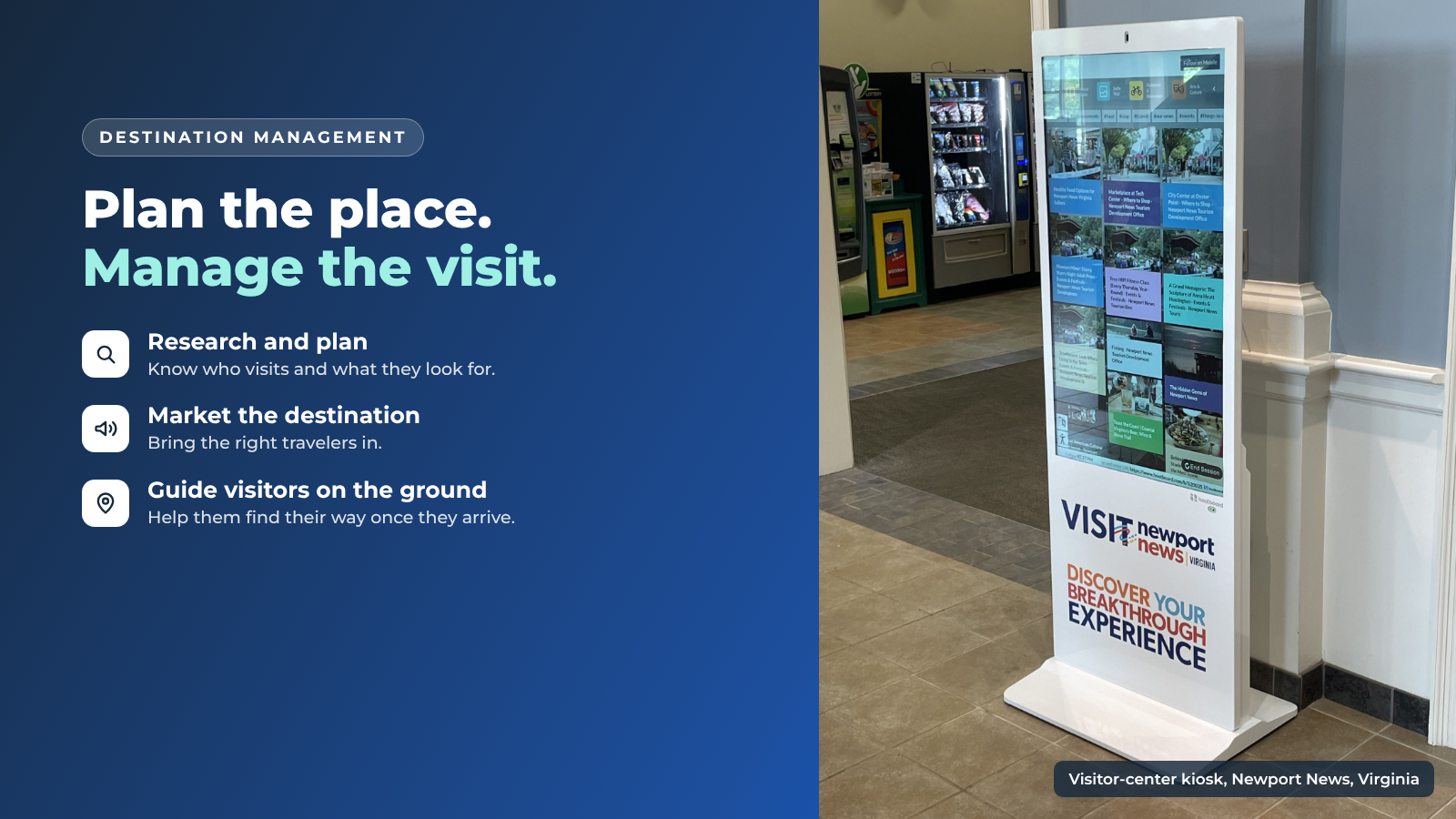
Once a traveler is in town, destination management becomes very practical. Can they find the trail, the restaurant, the event, the restroom? Many DMOs run that part with HootBoard, a kiosk operating system and content platform built for visitor centers and public spaces.

Here is what that looks like in practice:
- A visitor-center kiosk that works around the clock. A touchscreen tourism kiosk outside the welcome center keeps answering questions after staff go home.
- City Guide. Attractions, trails, restaurants and partner businesses on a map and in a list, with photos, detail pages, itineraries and QR directions, in multiple languages.
- Featured partner listings. Featured businesses show first in the City Guide list, which gives partners visibility and gives the DMO a way to help fund the program.
- Events and alerts. Event feeds from your calendar, or from partners like Simpleview and Tempest, publish straight to the screens. Emergency alerts can take over every screen in the network when needed.
- One hub, three channels. Publish once, and the same content shows on kiosks, on signage screens in hotels and attractions, and on visitors' phones through a QR code or a public web link.
The last piece feeds the research pillar. HootBoard analytics show where visitors are from, how long they stay at the screen, their travel group, top searches, QR scans and which apps they open, per screen. This is the in-destination data most DMOs do not have.

You can read more about using that data in data-driven destination management with kiosks.
DMOs such as Visit Santa Rosa, Visit South Bend Mishawaka, Visit Pennsylvania and Visit Newport News run HootBoard today. A first screen can be live in under 30 minutes, with no IT team needed. Most DMOs start with one screen on the always-free Launch plan and grow from there. You can see what is in each plan on the pricing page.
Putting destination management to work
Destination management is the work that turns a place into a destination people choose, enjoy and return to. It covers research, product, marketing, visitor management, measurement and partnership, and in the US it is usually led by the DMO.
The piece most destinations under-invest in is the visitor's time on the ground. A visitor-center kiosk, a live city guide and good analytics close that gap and give the DMO the data to plan the next season.
Book a demo to see how DMOs set up a visitor-center kiosk and city guide.
Frequently asked questions
What is the definition of destination management?
Destination management is the coordinated planning, development, marketing and management of a place for visitors. It is done in a way that benefits visitors, residents and local businesses together. It covers research, attractions and events, marketing, visitor information, crowd and season management, measurement and work with local partners.
What is the difference between destination management and destination marketing?
Destination marketing attracts visitors to a place. Destination management includes marketing, but it also covers what happens before and after: product development, visitor information on the ground, spreading crowds, working with partners and measuring results. Marketing is one part of the bigger job.
Who is responsible for destination management in the US?
Usually a destination management organization (DMO). That might be a convention and visitors bureau, a tourism board, or a city, county or state tourism office. DMOs work with local government, businesses and residents, because no single group controls a whole destination.
What do destination management companies do?
A destination management company (DMC) is a private firm that arranges tours, transportation, hotel blocks, meetings and events for groups traveling to a destination. It knows local suppliers and handles the logistics on the ground. A DMC serves its clients, while a DMO serves the destination as a whole.