
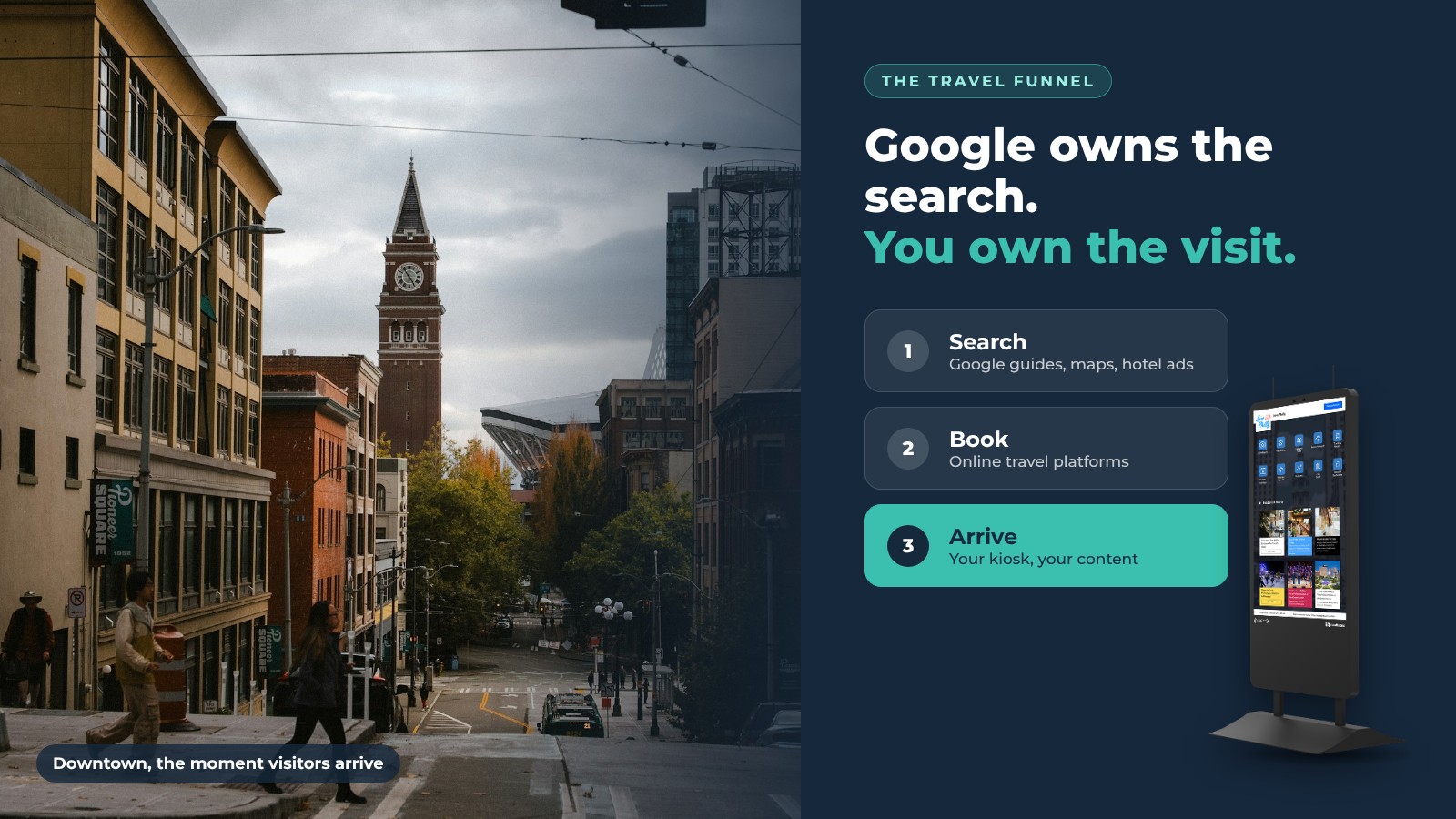
Most trips now start with a search. Before a traveler reaches a destination's website or a hotel's own booking page, Google Travel has already shaped what they see: Maps, hotel listings, price comparisons and its own travel guides.
That shift has changed tourism in two ways.
- DMOs have lost the first touch. The traveler who searches "things to do in" a city meets Google's guide before the destination's.
- Hotels have lost the last touch. The booking often arrives through an online travel agency, with a commission attached and little guest data.
Both losses come from the same fact. A platform now sits between the place and the people visiting it.
But one part of the journey belongs to no search engine: the visit itself. This post is about how DMOs and hotels can win that part back together.
Who really owns the visitor?
For destinations
Even strong DMO brands see their website traffic pulled into Google's travel guides and map results. Less first-touch traffic means less say over what visitors see, do and book once they arrive.
It also means fewer first-party signals about what visitors actually want. The DMO learns less about its own guests every season.
For hotels
Online travel agencies and metasearch bring visibility. But the property pays a commission on the booking and rarely gets the guest's contact details or preferences. The relationship belongs to the platform.
In both cases, the thing being lost is the same: first-hand knowledge of the visitor.

You can't outspend Google, but you can out-experience it
Google wins because it controls attention, not hospitality. Bidding against the big booking platforms for ad space only deepens the dependence.
The place the algorithm can't reach is the physical one. When a traveler walks into the visitor center, the hotel lobby or the downtown district, the search results fade into the background.
That is where a destination can rebuild the relationship. It needs on-site touchpoints that carry its own content, partners and insight into the real world.
The missing layer: on-site visitor hubs
For destinations
Interactive tourism kiosks at the welcome center, downtown and at partner venues work as digital visitor centers. They:
- Show attractions, events and partner hotels from the DMO's own listings, not a platform's ranking.
- Let visitors take any page with them by QR code, which sends them to the DMO's content instead of a generic listing.
- Report anonymous analytics: what visitors search for, how long they stay, where they came from and which apps they open.
- Give partner hotels and attractions featured listings that show first in the City Guide, under the DMO's control.
For hotels
A lobby kiosk becomes the concierge desk that never closes. It can show:
- The local guide, events and dining, pulled from the DMO's content, so the hotel doesn't have to maintain its own.
- Partner offers and the hotel's own promotions.
- A QR code to the property's own booking page for the next stay, and to its loyalty or newsletter sign-up.
- A short feedback form or survey that guests can answer on the spot.
Together, the DMO and the hotel keep the traveler inside the destination's own world for the part of the trip that matters most.

What this looks like in practice
A DMO places kiosks where visitors arrive: the visitor center, the convention center, the main downtown corner. Partner hotels add a kiosk in the lobby that runs the same destination content, with their own offers on top.
Both sides can see what visitors looked for this week, which neighborhoods drew the most interest and how many pages were sent to phones.
The DMO uses that to shape seasonal marketing and to show its board what the program does. The hotel uses it to decide what to promote at the front desk and to steer next-stay bookings to its own channel.
Visit Newport News runs HootBoard kiosks in this public-facing role for its destination. The same model works for a single visitor center or a whole region.
The DMO-hotel partnership model
How it works
- The DMO installs kiosks at busy public points: the visitor center, the airport, downtown, museums.
- Hotels add kiosks in their lobbies or at partner venues.
- Both run on the same HootBoard dashboard. Listings, events and partner offers publish once and appear everywhere, while each screen keeps its own board.
- Every screen reports into one analytics view, so both sides see what visitors search, scan and open.

What the DMO gets
- Visitation data to share with stakeholders.
- Partner visibility it can measure, which strengthens hotel and attraction relationships.
- Less dependence on paid search and platform referrals for influence once visitors are in town.
What the hotel gets
- A concierge that is always on, without building its own guide.
- A direct path to repeat bookings and loyalty sign-ups.
- Insight from the DMO on what visitors want this season.
A joint action plan
These four steps work for a single DMO and one partner hotel, or for a whole network.
Step 1: Audit the touchpoints
List every point from the first search to departure. Mark each place where a third party owns the interaction.
Step 2: Connect what you already have
Pull your events calendar, your Simpleview or Tempest listings and your partner offers into the kiosks through built-in integrations. Use Zapier for everything else.
Step 3: Give visitors a reason to act on site
Promote "book direct", "stay local" and partner passes on the kiosk, and send them to the visitor's phone by QR code.
Step 4: Measure together
Track interactions per kiosk, QR scans, top searches and repeat visits on the kiosk side. Hotels can add their own direct-booking numbers. Report the results jointly.
From clicks to footsteps
The new travel economy won't remove Google. It will rebalance it. Discovery will still start online, but loyalty and insight will belong to the destinations and properties that invest in what happens after arrival.
HootBoard was built for that moment. City Guide, Events and Directory carry the destination's own content. AirX and Versi kiosks cover lobbies, visitor centers, sidewalks and trailheads. QR handoff moves everything to the visitor's phone, and analytics turn footsteps into evidence.
A board is live in under 30 minutes and runs without IT. When you add more screens or apps, the plans show what each level includes.
Frequently asked questions
Why do destinations lose traffic to Google Travel?
Google answers travel searches with its own guides, maps and hotel listings before it shows a destination's website. The first touch happens on Google, not with the DMO.
How can a DMO and a hotel share one kiosk network?
Both run boards on the same HootBoard dashboard. The DMO publishes destination content once, and each hotel adds its own offers on its lobby screen. Both sides can see the analytics.
Does the kiosk take hotel bookings?
No. It shows the hotel's offers and sends the guest to the property's own booking page by QR code, so the booking stays direct.
What does a visitor kiosk tell a DMO that a website doesn't?
It shows what people look for after they arrive: top searches, dwell time, where visitors came from, which apps they opened and which pages they sent to their phones.
Want to see a destination board and a hotel board side by side? Book a demo and we'll walk you through both.