
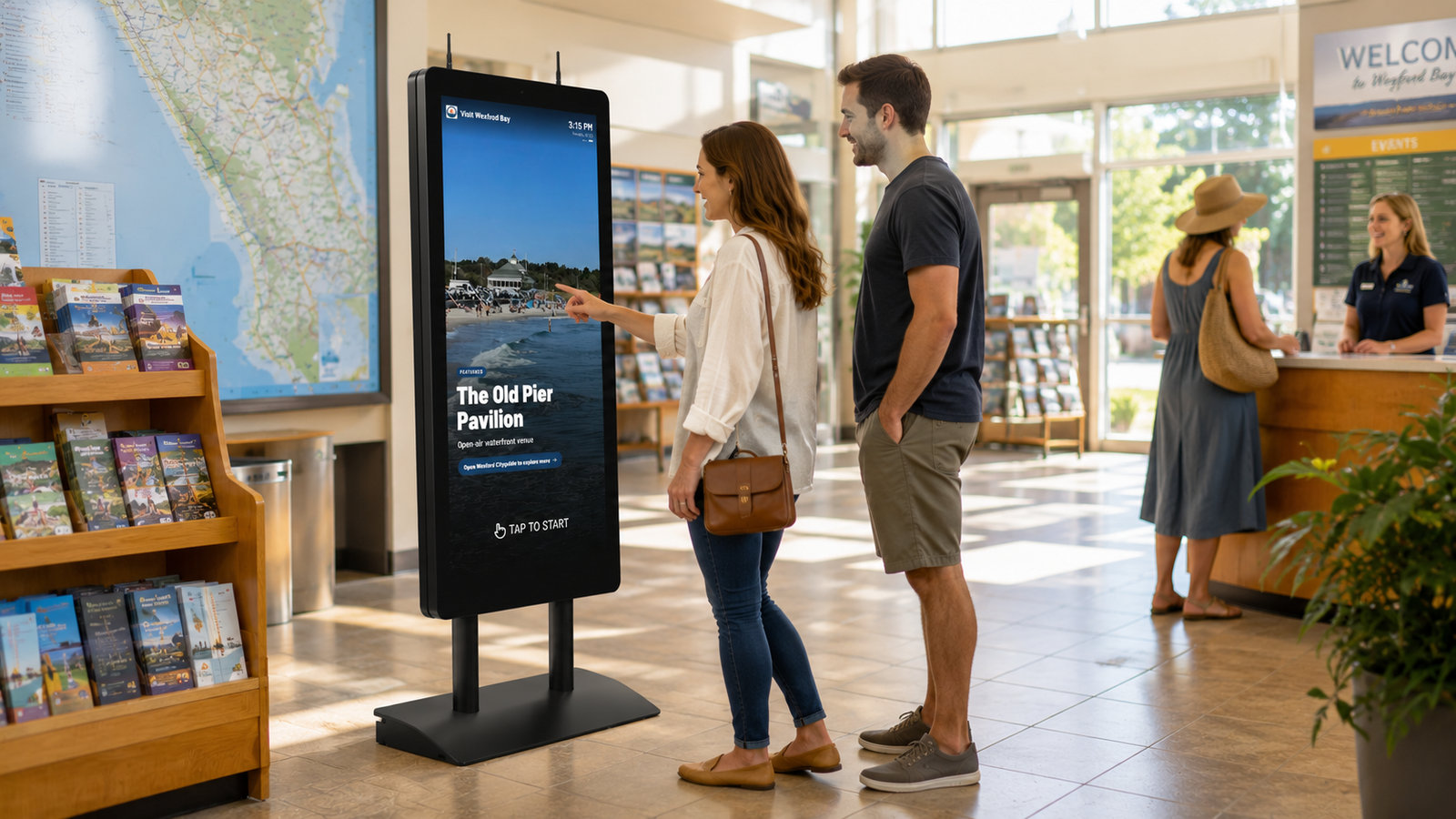
Your screens should work with the tools you already use, and staying with us should be a choice, never a constraint. Here's why we built HootBoard so both of those are true.
Whether you run a visitor center, a city, a campus, or a workplace, you already run a stack. An events calendar the whole team lives in. A CMS your web person guards with their life. A booking engine, an HR platform, a transit feed, social channels that took years to build an audience for. The last thing you need is a screen in your lobby that pretends none of it exists.
Yet that's the quiet norm in kiosk and signage software: proprietary content formats, per-connector fees, integrations that appear on the pricing page but not in the product. Somewhere along the way, “integration” became a line item instead of a courtesy.
We think that's backwards, and we've decided to put what we believe in writing.
The manifesto
These aren't features. Features get deprecated. These are constraints we place on ourselves.
- We will integrate with any platform willing to integrate with us. If you're open to us, we're open to you. That includes tools that overlap with things we already do.
- We will never charge a platform to integrate with us. No pay-to-play partner program, no listing fees, no revenue share demanded at the door. If a tool your community uses wants to connect, the price of admission is willingness.
- We will reach for open standards first. iCal, RSS, GTFS, the open web: when a standard exists, we build on it before we build anything bespoke, so your connections never depend on a private bridge that only we can maintain.
- We will never hold your content hostage. Everything your team puts into HootBoard remains yours, exportable, always. Leaving should be easy. Staying should be a choice.
None of these pledges depends on which plan you're on.
One thing they don't promise is timing. New connections get built in the order our customers need them, and if you ask for one, we'll tell you plainly where it sits on the list.
Why we can promise this
Here's something worth saying out loud: some vendors lock you in by design, because captive customers are profitable. But many do it for a humbler reason: their architecture gives them no choice. When a platform can only display what's authored inside it, everything outside its walls is a threat.
HootBoard was built the other way around. Everything still runs inside one platform, which is what keeps your screens coherent and manageable. But the platform treats the outside world as data and services to be integrated, not as a threat. Connections are built on open standards first, with custom bridges for the cases that need one, which means there is very little we cannot bring in. A city's events calendar, a university news feed, a real-time bus tracker, a tour booking widget, a company announcement from the comms team: to HootBoard they are all just sources, and they all show up side by side, without a fight.
We didn't have to re-architect anything to make these promises. The platform was built this way from day one. That's the point.

The honest part: openness is good business
This isn't altruism, and we won't pretend it is.
Every connection makes your screens more useful. A kiosk that surfaces your whole stack becomes the busiest employee in the building, and that's much harder to replace than one that only shows ours. Openness compounds in our favor.
Easy-to-leave keeps us honest, too. When exit costs nothing, every renewal has to be earned by the product, not by the switching costs. We prefer that pressure. Lock-in is what you build when you're not sure people would stay.
And trust moves faster than features. Buyers who don't have to plan an escape route say yes sooner. We'd rather win the deal because saying yes felt safe.
The bar is higher when the money is public
HootBoard screens stand in visitor centers, transit hubs, student unions, libraries, city halls, and corporate headquarters. For many of the organizations we serve, what pays for them is grant money and taxpayer money, and technology bought with public money deserves a higher bar: interoperability, data portability, and terms that don't quietly marry an institution to a vendor.
Procurement teams and grant programs increasingly require exactly that, and they're right to. Private organizations should demand the same, for the same reason: switching costs are a tax on your future options, whoever is paying.

What this looks like today
None of this is aspirational. HootBoard Connect already ships purpose-built connectors across every world we serve: Simpleview, Tempest, CivicPlus, and Govstack for destinations and cities. Google Calendar, Outlook, Eventbrite, and iCal for events wherever they're managed. WordPress, Canva, Instagram, Google Drive, and RSS for content teams. FareHarbor for bookings, Google Maps and live weather for context, GTFS for real-time transit. And where we don't have a purpose-built connector, Zapier bridges to thousands of other apps.
Notice how many of those are open standards: iCal, RSS, GTFS, the open web itself. We reach for the standard before the bespoke bridge, so nothing in your lobby depends on us maintaining a hundred one-off connectors.

The door is open
To platforms: if your users overlap with ours, we're probably already compatible. Come talk.
To our customers, current and future: if your team runs a tool we don't connect to yet, tell us. Requests like that are exactly how HootBoard Connect has grown so far, and they're the first thing we look at when we plan what to build next.

Want to put us to the test? Write to support@hootboard.com with the tool you wish your screens talked to. We'll take it from there.
v1.0, July 2026