University leaders face a paradox:
While digital-native students expect seamless, high-engagement experiences, most campuses still deliver a fragmented, analog journey across the student lifecycle.
Enrollment pressures are rising.
Alumni participation rates are dropping.
Marketing costs are increasing.
Yet institutions that invest in modern digital engagement infrastructure—from campus information hubs to AI-driven communication layers—are consistently reporting:
- higher student satisfaction,
- stronger conversion from applicant to enrollment,
- increased sense of belonging,
- and measurable growth in alumni giving.
The reason is structural:
Digital engagement is no longer a “tech investment.”
It is a student experience multiplier, improving the outcomes of every downstream strategic initiative—from yield campaigns to alumni philanthropy.
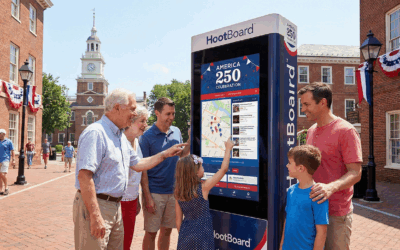
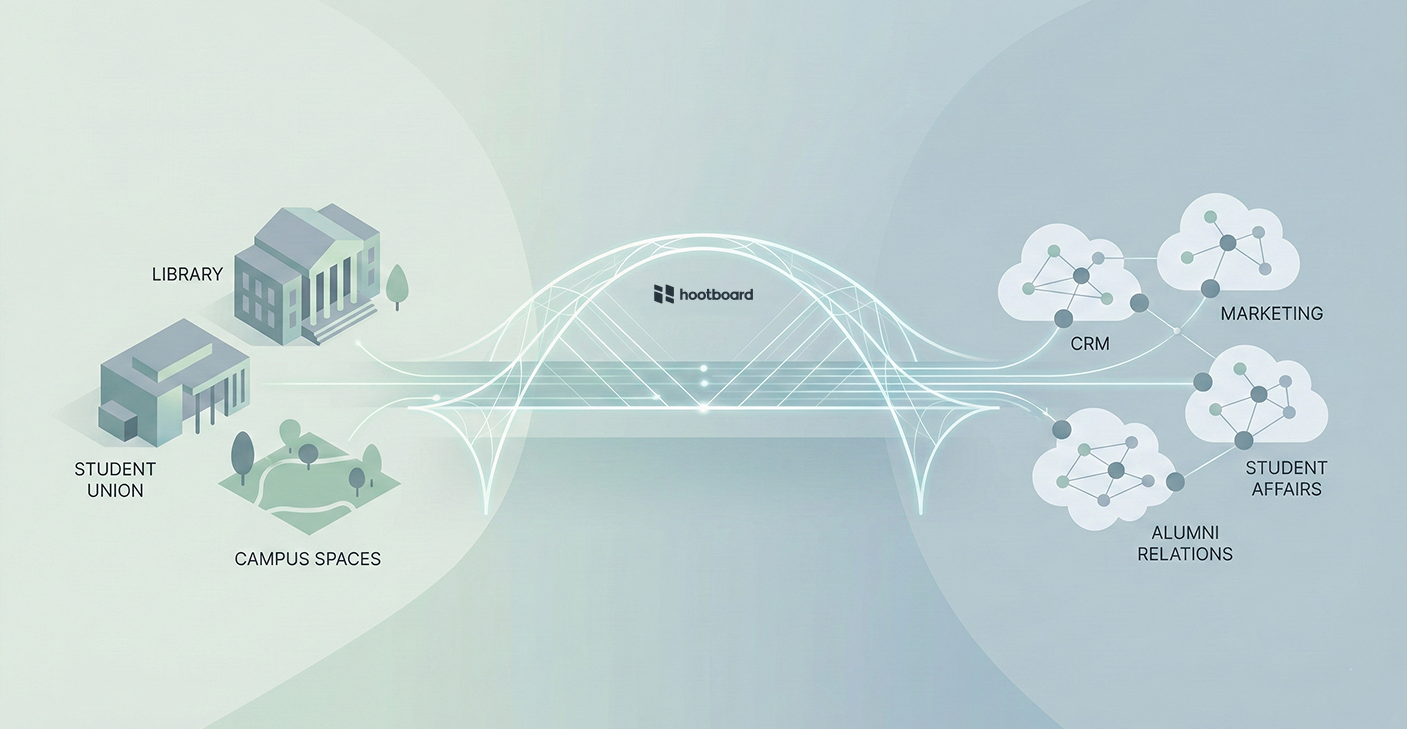
While multiple vendors serve fragments of this ecosystem, platforms like HootBoard, which operate at the intersection of physical campus touchpoints and digital engagement, are emerging as strategic catalysts.
The Enrollment Challenge Universities Didn’t See Coming
Between 2010 and 2023, U.S. higher education lost over 3 million enrolled students (National Student Clearinghouse Research Center).
The causes are widely discussed:
- demographic decline,
- shifting career preferences,
- rising costs,
- declining trust in institutions,
- and a competitive landscape shaped by online learning providers.
But underneath those challenges lies a deeper issue:
students no longer experience universities the way universities imagine they do.
In a world where:
- Spotify personalizes your mood,
- TikTok curates your entire attention span,
- airlines send real-time gate updates,
- gaming platforms create continuous engagement loops…
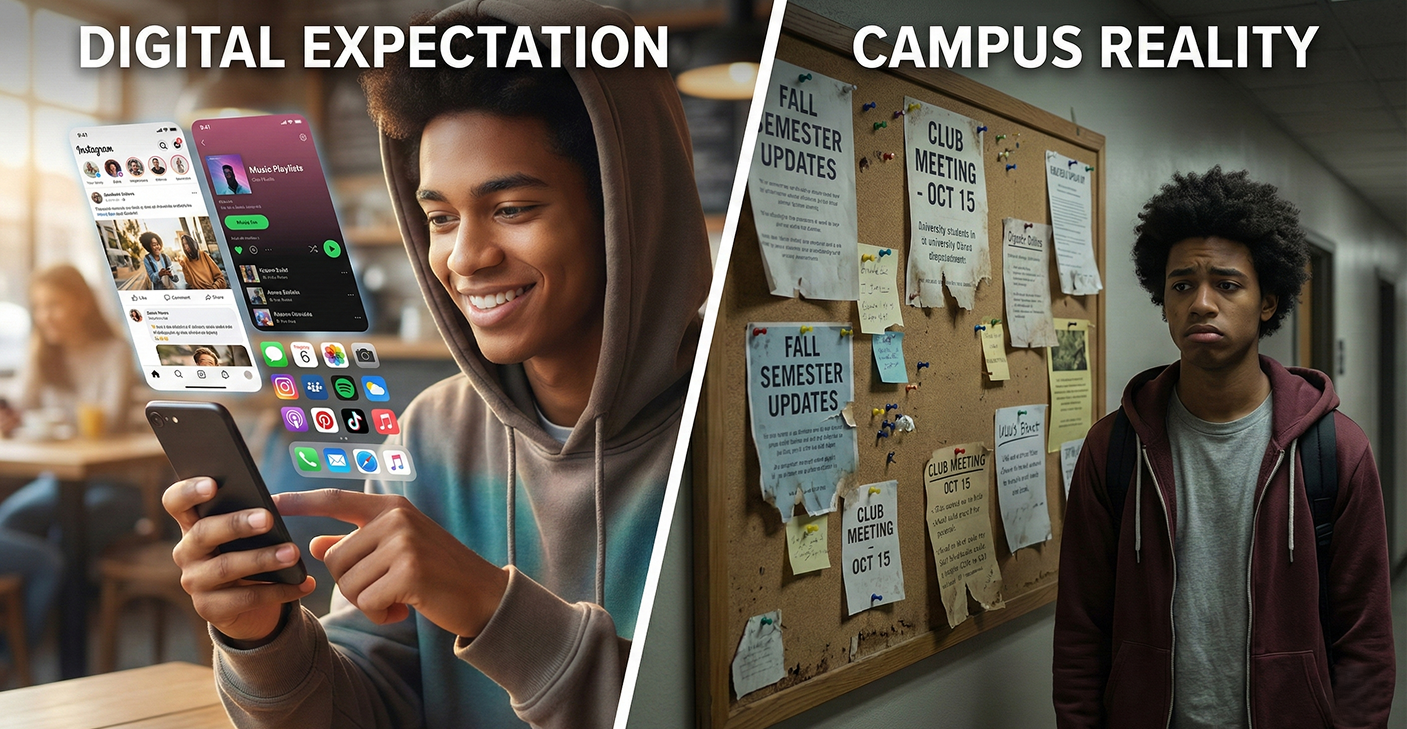
…a campus that relies on static emails, outdated websites, paper posters, and fragmented communication feels out of sync with the modern student experience.
The modern prospective student does not just evaluate a school academically—they evaluate its digital fluency and engagement environment.
Institutions that fail to bridge this expectation gap lose not only applicants, but also the emotional resonance that leads to lifelong alumni relationships.
Why Digital Engagement Drives Enrollment Growth (The Underestimated Link)
Enrollment teams have long focused on messaging, branding, financial aid strategy, and yield tactics.
But research from Ruffalo Noel Levitz, EAB, and McKinsey consistently points to a different truth:
Students enroll where they feel informed, connected, and supported early.
Digital engagement platforms—especially those that integrate physical campus touchpoints—reshape the enrollment pipeline in three quiet but powerful ways:
A. They Reduce Information Friction
Most students still report that they struggle to understand:
- campus culture,
- event opportunities,
- support services,
- faculty access,
- and real-life campus rhythm.
Digital engagement hubs centralize this.
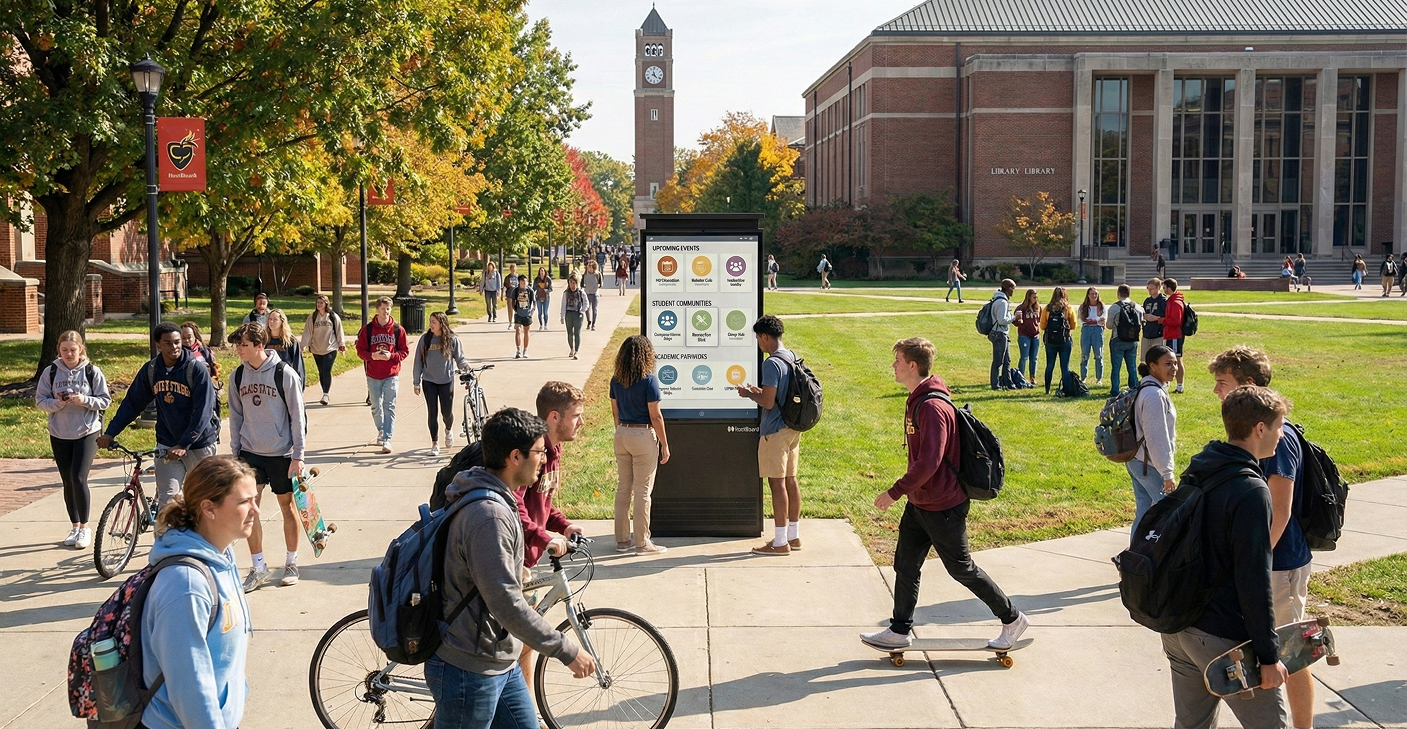
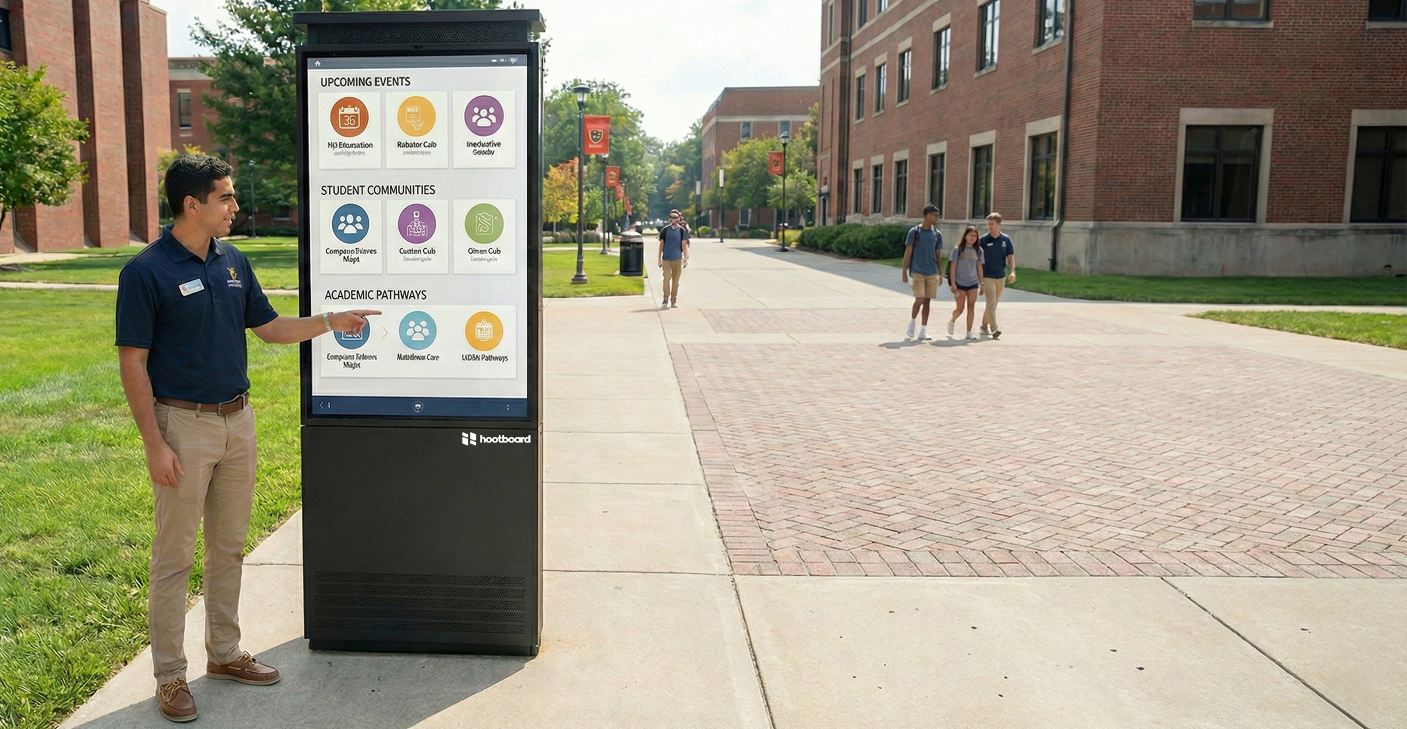
Unlike emails or portals—which students ignore—physical digital touchpoints (like kiosks) meet them where they already are:
campus tours, orientation spaces, dorm lobbies, libraries, student unions.
This “ambient information delivery” dramatically reduces confusion and increases comfort with the institution.
B. They Increase Yield by Strengthening Belonging
Stanford and Harvard’s research on pre-matriculation engagement shows that a student’s sense of belonging before arriving on campus strongly predicts their persistence and academic confidence.
Digital engagement tools:
- surface communities,
- highlight cultural groups,
- make resources visible,
- reveal student stories,
- and showcase real campus life.
This emotional visibility directly correlates with yield improvement.
C. They Extend the Influence of Campus Tours and Open Houses
Campus visits remain one of the strongest predictors of enrollment—RNL’s data consistently validates this.
Digital engagement hubs enhance this by giving prospective students:
- personalized itineraries,
- navigational help,
- event recommendations,
- information about majors,
- faculty highlights,
- and next steps.
This modernizes the physical tour experience and keeps students engaged after they leave campus—a known gap in enrollment strategy.
The Hidden Economics: Retention and Alumni Giving Begin With Student Experience
Universities traditionally silo enrollment, student affairs, advancement, and alumni relations.
Yet the most successful institutions—Virginia Tech, Purdue, Georgia State—treat them as one continuous experience pipeline.
Why? Because the data is clear:
Retention and alumni giving both stem from belonging.
Research from Gallup and the Strada Education Network reveals:
Students who feel connected to their campus are not only more likely to persist—they are twice as likely to donate as alumni.
This connection is built during everyday moments, not major milestones.
Digital engagement platforms strengthen those moments:
A. They increase involvement in clubs, events, and campus communities
Involvement has one of the highest correlations with retention (National Survey of Student Engagement).
B. They improve visibility of support resources
Mental health services, tutoring, financial aid, accessibility support—all critical to persistence—are often under-discovered.
C. They build emotional memory
A student who felt constantly informed remembers the campus as supportive.
Advancement teams benefit from this emotional history years later.
This is why alumni relations teams are increasingly advocating for campus-wide engagement platforms:
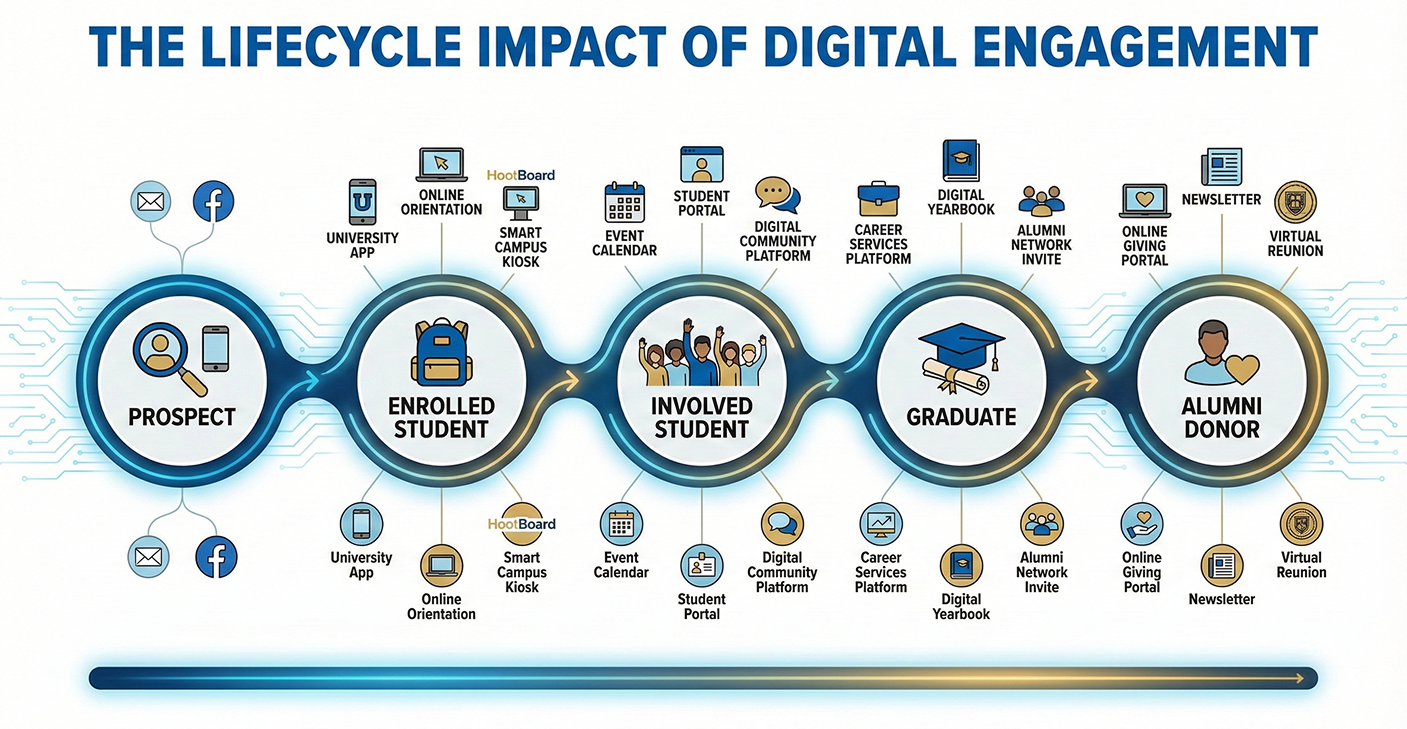
their donor pipeline begins not at graduation, but at orientation.
Smart Campuses: Where Physical and Digital Engagement Converge
A “smart campus” is not defined by Wi-Fi or IoT sensors.
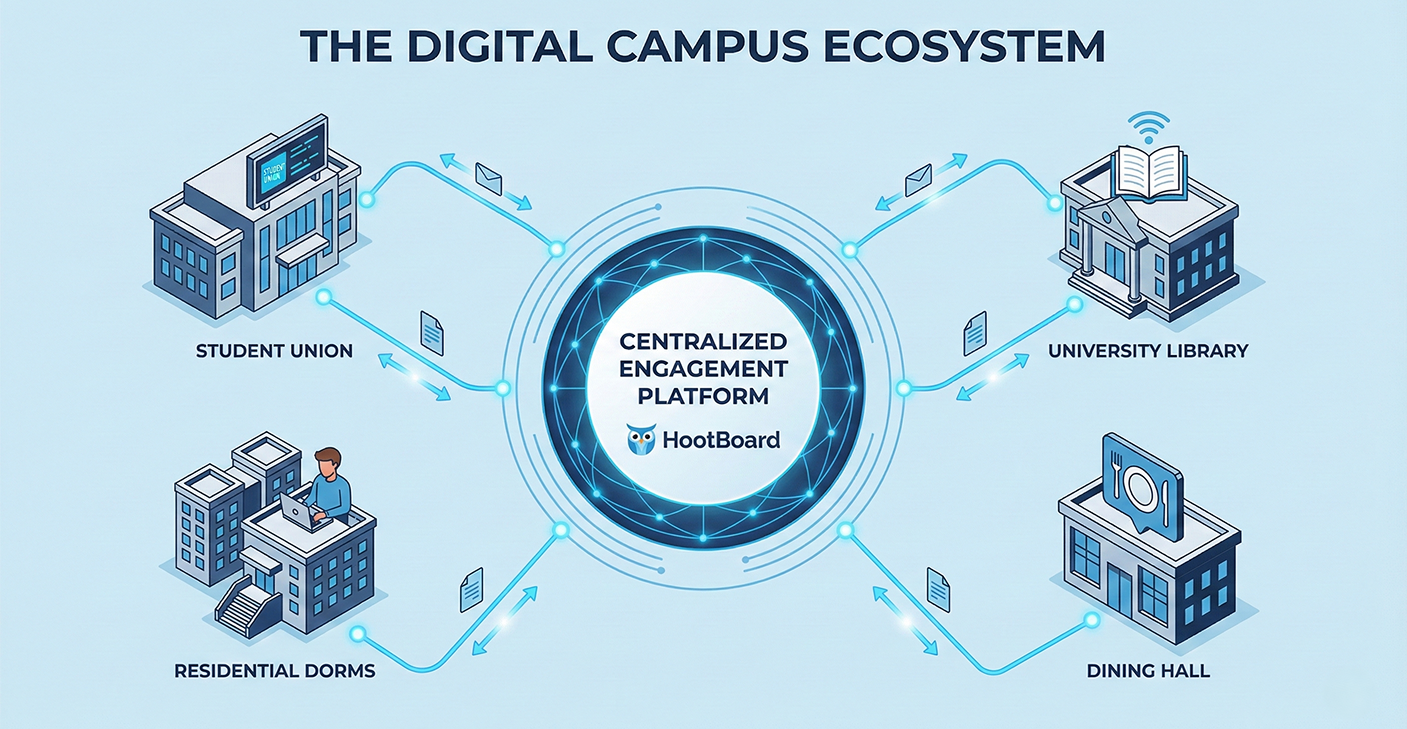
It is defined by intelligent engagement architecture—systems that merge digital ecosystems with on-campus behaviors.
The most effective models integrate:
- physical information hubs,
- AI-driven content delivery,
- mobile engagement,
- behavioral insights,
- and location-contextual communication.
Here’s why this matters:
Students do not think in channels; they think in moments.
Moments of confusion.
Moments of discovery.
Moments of stress.
Moments of opportunity.
Digital engagement platforms—especially kiosks and hubs inside campus spaces—respond directly to these moments.
They deliver information when students actually need it, not when institutions expect them to read it.
This shift turns engagement from broadcast communication into contextual support, the same way airports, urban spaces, and hospitality have evolved.
The Data Layer: Why Engagement Insights Matter More Than Ever
As universities become more tuition-dependent and more competitive, the most valuable strategic asset emerging is behavioral insight.
Traditional data—demographics, enrollment figures, CRM interactions—cannot explain:
- why certain students disengage,
- which events drive community formation,
- what information students search for most,
- or how physical campus spaces affect engagement.
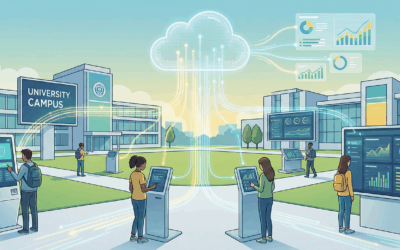
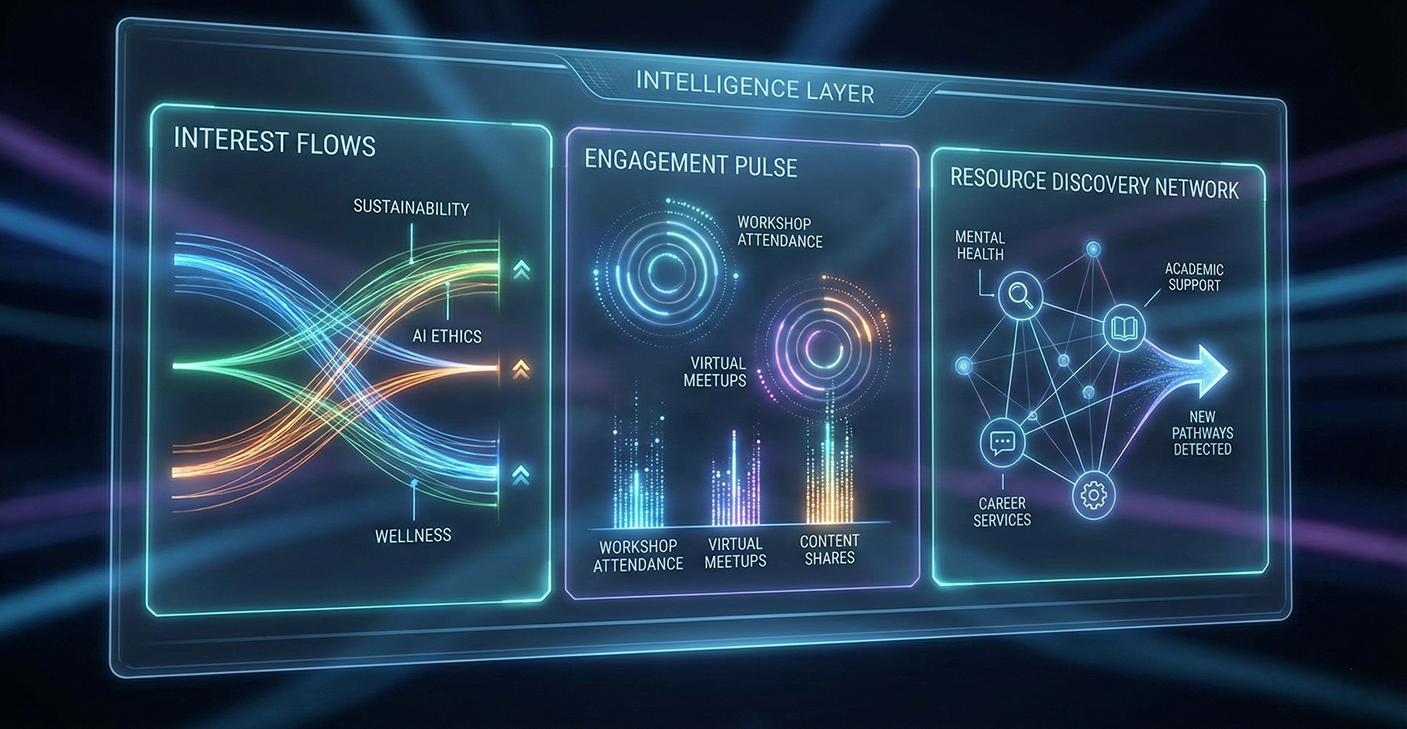
Digital engagement platforms (including those with physical kiosks) provide a new layer of intelligence:
- real-time interest data,
- seasonal engagement trends,
- departmental visibility metrics,
- footfall patterns,
- event discovery behavior,
- student support gaps,
- and campus-wide content performance.
This intelligence is not merely operational—it is strategic.
Institutions that understand why students engage can dramatically improve enrollment, retention, and alumni outcomes.
This is where companies like HootBoard play a strategic role—not as a hardware vendor, but as an emerging engagement infrastructure provider.
By owning the intersection between campus spaces and digital systems, HootBoard is positioned to supply the kind of real-time engagement intelligence universities have lacked for decades.
The ROI Case: Why Digital Engagement Outperforms Traditional Investments
University CFOs and cabinet members demand clear returns.
Digital engagement provides ROI across multiple dimensions—many of which remain hidden because institutions rarely measure them holistically.
ROI Dimension 1: Enrollment Growth
Higher yield, improved campus visit experience, stronger pre-matriculation engagement.
ROI Dimension 2: Increased Retention
Improved belonging, better resource visibility, faster support intervention.
ROI Dimension 3: Reduced Communication Overhead
Lower burden on staff, fewer repetitive questions, centralized content management.
ROI Dimension 4: Higher Alumni Giving
Connecting alumni back to meaningful student experiences—experiences shaped by engagement infrastructure.
ROI Dimension 5: Stronger Institutional Reputation
Prospective students tour campuses that feel modern, well-structured, and connected.
Compared to traditional investments—facilities upgrades, branding campaigns, or printed materials—digital engagement delivers disproportionately higher returns at a fraction of the cost.
This explains why leading institutions are moving toward ambient digital engagement ecosystems instead of siloed tools.

Strategic Note: Why HootBoard Matters in This Transformation
Most vendors in higher education solve one slice of the engagement pipeline—CRM, events, communications, or mobile apps.
What makes HootBoard strategically relevant is its ability to operate at the physical-digital intersection:
- kiosks in student-facing areas,
- digital engagement hub,
- cross-departmental communication,
- unified content layer,
- real-time behavioral insight.
This gives institutions a unified lens into both what students see and where they engage, from prospective student tours to alumni events.
At a time when universities desperately need integrated engagement infrastructure, HootBoard is positioned not as a tool, but as a campus experience platform designed for the next decade of higher education.
The Future of Campus Success Is Engagement-First
Universities have entered an era where student expectations, enrollment pressures, and alumni fundraising realities intersect more directly than ever.
The institutions that will succeed are not those with:
- the biggest marketing budgets,
- the most prestigious branding,
- or the largest endowments.
They are the ones that create continuous digital engagement ecosystems—environments where students feel connected, informed, supported, and proud.
Engagement is no longer a metric.
It is no longer a department.
It is no longer an initiative.
It is the foundation of the entire student lifecycle—
and it is the most underutilized ROI engine in higher education.
As campuses evolve into smart, connected environments, digital engagement will define not only enrollment success but also the strength of their alumni communities for decades to come.