Career services offices were never meant to feel invisible.
They exist to be one of the most consequential touchpoints in a student’s academic life — the bridge between education and livelihood, between theory and reality. Yet on many campuses today, career services are struggling with a paradox of their own: they are more important than ever, and less engaged with than ever before.
Students know they need help navigating careers.
Universities know employability outcomes matter — to rankings, accreditation, enrollment, and public trust.
Employers know early access to talent is critical.
And yet, the systems connecting these groups often feel outdated, fragmented, and easy to ignore.
The result is a widening gap between opportunity and awareness.
The Quiet Decline of Traditional Career Engagement
For decades, the career services playbook changed very little.
Career fairs once or twice a semester.
Email job alerts.
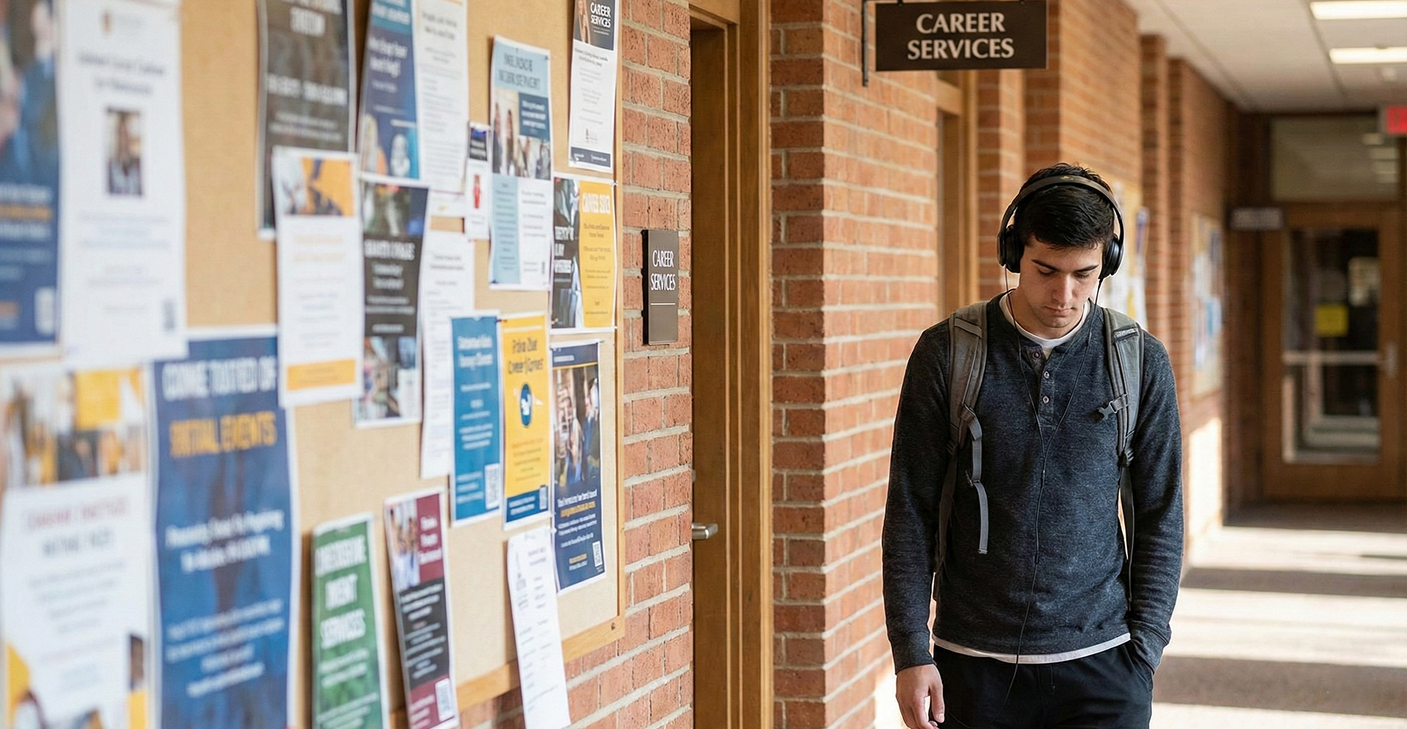
Static job boards buried inside portals students rarely open.
Occasional workshops that compete with academic schedules.
This model assumed something that is no longer true:
that students would actively seek out career resources on their own time, through their own initiative.
But student behavior has changed.
According to the National Association of Colleges and Employers (NACE), fewer than 40% of students regularly engage with career services before their final year, despite overwhelming evidence that early exposure significantly improves employment outcomes. At the same time, surveys consistently show that students feel underprepared for the job market.
This is not a motivation problem.
It’s a visibility and access problem.
Students are not ignoring career services because they don’t care.
They’re ignoring systems that don’t meet them where they are.
Why Email and Career Fairs No Longer Work at Scale
Email remains the dominant communication channel for career offices — and one of the least effective.
Open rates for university bulk emails routinely fall below 25%, and click-through rates are often in the low single digits. Job alerts compete with academic notifications, administrative reminders, and student organization spam. Important opportunities disappear into noise.
Career fairs, while valuable, are episodic by nature. They favor students who already know how to navigate professional environments and disadvantage those who are undecided, introverted, or unaware of what roles even exist. For first-generation students in particular, these formats can feel intimidating rather than empowering.
The underlying issue is timing.
Careers are not decided in a single afternoon or inbox notification.
They emerge through repeated exposure, curiosity, and low-pressure exploration.
Current systems are built for transactions.
Students need discovery.
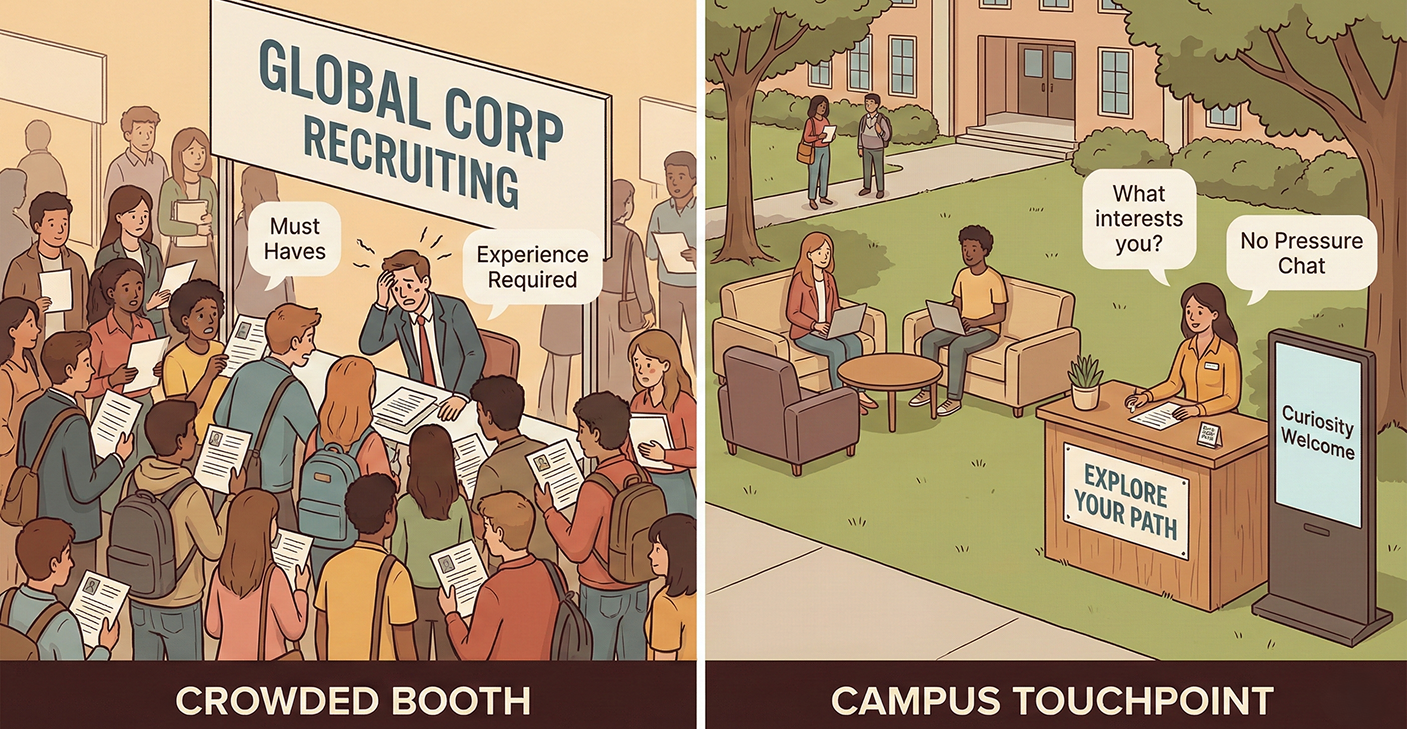
The Case for Ambient Career Discovery on Campus
The most effective career guidance often happens informally — when students stumble across roles they didn’t know existed, or see pathways they hadn’t considered.
This is where physical-digital touchpoints, particularly interactive kiosks, offer a fundamentally different model for career engagement.
Not as replacements for advisors.
Not as job boards on a screen.
But as always-on discovery points embedded into campus life.
Placed strategically — in student centers, libraries, residence halls, dining areas — kiosks transform career services from a destination students must seek out into a presence they encounter naturally.
This shift matters.
Behavioral research consistently shows that frictionless exposure increases engagement, especially among populations that are uncertain or underconfident. When access feels optional and exploratory rather than mandatory or evaluative, participation broadens.
From Static Listings to Real-Time Opportunity
Most campus job boards are static by design. Students log in, search, scroll, and log out. There is little sense of urgency or relevance.
Kiosks enable a different experience.
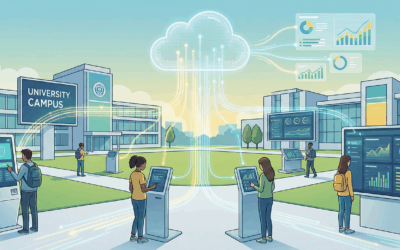
They surface real-time job and internship opportunities, tailored to context:
- On-campus roles
- Local internships
- Part-time work aligned with academic schedules
- Employer postings relevant to the university’s programs
Instead of asking students to hunt, kiosks present opportunities in moments of attention — between classes, during breaks, while waiting.
This is not about replacing existing systems.
It’s about making them visible.

AI-Powered Career Matching Without the Intimidation
Career matching tools exist today, but many students never use them.
Why?
Because they often feel like assessments — something that judges rather than guides. Long questionnaires, abstract personality models, and unclear outcomes create friction.
When AI-powered career matching is embedded into kiosks, the dynamic changes.
The interaction becomes:
- Short
- Optional
- Curiosity-driven
Instead of asking, “What job do you want?”, kiosks can ask:
- What subjects interest you?
- What skills do you enjoy using?
- Are you looking for flexibility, learning, or income right now?
From these lightweight signals, AI can surface:
- Relevant roles
- Internships aligned with interests
- Skill-building opportunities
- Career paths students hadn’t considered
Importantly, this matching does not require identity.
It works on intent and preference, not personal data.
That distinction is critical in university environments, where privacy, ethics, and consent are paramount.
Equity, Access, and the Hidden Power of Visibility
One of the most compelling arguments for kiosk-based career discovery is equity.
Students who benefit most from career services are often the least likely to engage with them:
- First-generation students
- International students
- Students from non-dominant socioeconomic backgrounds
- Students unsure of “professional norms”
By embedding career exploration into shared spaces, universities reduce the social and psychological barriers that prevent engagement.
The opportunity becomes public, normalized, and approachable.
This matters not just for outcomes, but for institutional values.
Universities increasingly measure success not only by placement rates, but by who benefits from those placements.

What Career Services Teams Gain From This Model
For career services professionals, kiosks are not an added burden — they are a signal amplifier.
Aggregated interaction data reveals:
- What roles students are exploring
- Which industries attract attention
- Where interest outpaces opportunity
- When engagement spikes or drops
This insight helps teams:
- Adjust employer outreach
- Design targeted workshops
- Allocate advisor time more effectively
- Demonstrate impact to university leadership
Crucially, this data is behavioral and anonymized, aligning with institutional privacy standards while still informing strategy.
Why University Leadership Should Care
Career outcomes are no longer peripheral metrics.
They influence:
- Enrollment decisions
- Accreditation reviews
- Alumni giving
- Public perception
- Government and industry partnerships
Universities that fail to modernize career engagement risk appearing disconnected from student realities — regardless of academic excellence.
Kiosks offer a low-risk, high-visibility way to signal commitment to student success without forcing behavioral change.
They don’t require students to adopt new habits.
They adapt to existing ones.

The Future of Career Services Is Ambient, Not Episodic
Career readiness does not happen in a workshop.
It happens through repeated exposure, reflection, and confidence-building moments.
The future of career services is not louder emails or bigger fairs.
It is quietly present, continuously available, and designed for discovery.
Interactive kiosks, when thoughtfully deployed, do something powerful:
they make opportunity visible — without pressure, without surveillance, without friction.
In a world where students are overwhelmed with information,
visibility is the most underrated form of support.
And the universities that understand this will shape not just better careers — but more confident graduates.