
Personalization has become the baseline expectation in travel.
Guests expect relevance—quietly, instinctively.
They expect hotels to anticipate needs, destinations to guide them intuitively, and experiences to feel curated rather than generic.
At the same time, trust in data practices has never been lower.
According to Pew Research, 79% of adults say they are concerned about how companies use their personal data, and more than half believe they have lost control over it entirely. In hospitality, this concern is amplified by context: travel involves location, movement, timing, behavior, and emotion—data that feels more intimate than a shopping cart or streaming preference.
This tension—between the desire for personalization and resistance to data collection—is often described as the privacy paradox. But calling it a paradox oversimplifies the problem.
What travelers actually reject is not personalization.
They reject opaque extraction.
And that distinction matters.
The Real Problem: Data Collection Without Context
Most data systems used in travel and hospitality today were designed for scale, not trust.
Cookies, device IDs, app analytics, Wi-Fi logins, CRM enrichment—these tools operate quietly in the background. They collect continuously, often without a clear moment of consent or an obvious value exchange. From a technical standpoint, they work. From a human standpoint, they feel intrusive.
A Deloitte Digital study found that only 10% of consumers feel companies are transparent about how their data is used, even when consent mechanisms exist. The presence of a privacy policy does not equate to trust; in many cases, it signals legal obligation rather than ethical intent.
In hotels and travel businesses, this manifests in subtle but damaging ways:
- Guests avoid downloading hotel apps for short stays
- QR code interactions drop after novelty wears off
- Wi-Fi portals capture emails but deliver low engagement
- Loyalty programs collect data that goes unused or untrusted
The industry ends up with fragmented datasets and a widening trust gap.
More data, less clarity.
Why “More Data” Is No Longer a Competitive Advantage
For years, the assumption was simple: the more data you collect, the smarter your decisions become.
That assumption is breaking down.
Regulatory pressure is one reason. GDPR, CCPA, and newer frameworks like India’s DPDP Act enforce principles such as data minimization, purpose limitation, and explicit consent. But regulation alone does not explain the shift.
The deeper issue is data quality.
When users feel coerced, rushed, or suspicious, their behavior changes. They provide fake information. They abandon flows. They avoid engagement altogether. According to Forrester, up to 30% of customer data in enterprise systems is inaccurate or unusable, largely due to low-trust collection environments.
In travel, where visits are short and intent is time-bound, this problem compounds. A visitor who does not trust the system will not explore deeply. They will take the shortest path out.
This is where many personalization strategies quietly fail—not because the algorithms are weak, but because the inputs are compromised.
A Shift in Thinking: From Identity to Intent
The most important change happening in hospitality analytics is not technological. It’s philosophical.
Leading travel organizations are moving away from identity-centric data (“Who is this person?”) toward intent-centric data (“What are they trying to do right now?”).
This distinction is subtle but powerful.
Identity-based data requires:
- Persistent identifiers
- Long-term storage
- Cross-session tracking
- Higher regulatory and security risk
Intent-based data focuses on:
- Immediate needs
- Contextual behavior
- Aggregated patterns
- Short-lived relevance
And intent is often all you need to improve experience.
What guests search for, browse, or interact with at a given moment reveals more about how to serve them than a demographic profile ever could.

Why Physical-Digital Touchpoints Change the Equation
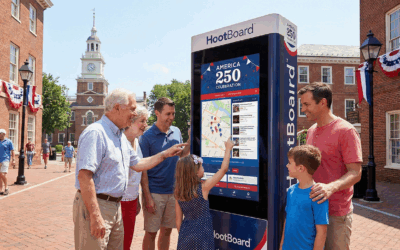
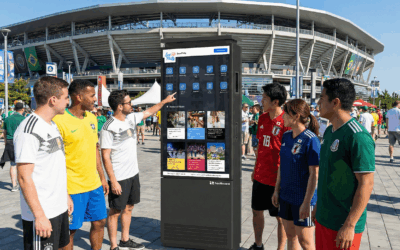
This is where interactive kiosks re-enter the conversation—not as hardware, but as a trust-preserving interface.
Unlike personal devices, kiosks are:
- Shared, not private
- Visible, not hidden
- Session-based, not persistent
That changes user psychology.
When someone approaches a kiosk, the interaction is deliberate. They know they are engaging. They understand the purpose. There is no illusion of invisibility.
Nielsen Norman Group research on trust in interfaces shows that users are significantly more comfortable sharing information when the system’s intent is obvious and the outcome is immediate. Kiosks naturally satisfy both conditions.
The data collected in these interactions is fundamentally different:
- Categories explored
- Destinations searched
- Language selected
- Time and location of interaction
No names. No emails. No cross-site identifiers.
Yet for travel businesses, this data is extraordinarily valuable.
It reveals:
- Demand patterns by time of day
- Seasonal shifts in interest
- Underperforming attractions
- Content gaps in wayfinding or recommendations
All without creating personal dossiers.
Privacy-First Analytics Is Not Data Poverty
A common fear among data teams is that privacy-first approaches limit insight.
In practice, the opposite is often true.
Aggregated, anonymized interaction data tends to be cleaner, more stable, and more actionable than over-segmented personal data. It supports strategic decisions rather than vanity metrics.
McKinsey’s work on customer trust indicates that organizations perceived as “responsible with data” see up to 20% higher engagement rates over time compared to peers relying on aggressive tracking.
Trust compounds.
Surveillance does not.

The Compliance Advantage No One Talks About
There is another, often overlooked benefit to kiosk-driven, intent-based data collection: regulatory resilience.
As privacy laws evolve, systems that rely on persistent identifiers become liabilities. Consent must be tracked, revoked, audited. Breaches carry reputational damage far beyond fines.
In contrast, systems built around anonymized interaction data:
- Reduce compliance overhead
- Minimize breach impact
- Align naturally with “privacy by design” principles
This is not just safer—it’s strategically sound.
For global travel brands operating across jurisdictions, reducing dependency on personal data simplifies operations and lowers long-term risk.
Rethinking Personalization in Hospitality
Personalization does not require knowing everything about a guest.
It requires knowing what matters in the moment.
A guest arriving late at night wants food options that are open.
A family in the afternoon wants nearby attractions.
A solo traveler in the evening wants safe routes and events.
None of this requires identity.
It requires context.
Interactive kiosks, when designed thoughtfully, become sensors for collective intent rather than tools of individual surveillance.

Conclusion: Trust Is the Longest-Lasting Data Asset
The privacy paradox dissolves when we stop framing data collection as extraction and start framing it as service.
Travelers are not unwilling to share information.
They are unwilling to be exploited.
In hospitality, where trust is the foundation of experience, the future belongs to systems that are:
- Visible
- Purpose-driven
- Minimal by design
- Respectful by default
The most valuable data will not come from tracking people across platforms.
It will come from listening carefully when they ask for help.